
India's largest cement firm, Ultratech Cement, has joined the race to acquire the Holcim stake in Ambuja Cements and its subsidiary, ACC. UltraTech - part of the Aditya Birla Group - submitted a non-binding bid on Wednesday. Swiss multinational Holcim, which manufactures building material, is exiting India by selling its 63.19% stake in Ambuja Cements. According to banking sources, UltraTech has submitted a plan to Holcim, outlining divestiture details that would meet the norms set by anti-trust body Competition Commission of India.

The FPI holding in India's top 100 companies, which are part of the Nifty 100 index, declined to 24.23 per cent on average at the end of March this year, from a high of 27.5 per cent at the end of March 2021. This is the lowest FPI holdings in India's top listed companies in at least three years. A general sell-off by FPIs has weighed on stock prices and the benchmark S&P BSE Sensex is down 8.5 per cent, from its 52-week high made in October 2021. Most analysts expect FPI flows to remain weak in FY23 as well, given rising bond yields in the US and an expected earnings slowdown in India due to high inflation and commodity prices.

The chairman of the JSW Group of companies, Sajjan Jindal, whose stake in the group is valued at $14.5 billion (Rs 1.1 trillion), is betting $4.5 billion of his personal fortune in the firm's bid for Ambuja Cements. According to bankers, Jindal's contribution will be a combination of share sale and debts raised by pledging the stake of the target entities with private equities. The JSW Group chairman has offered $7 billion for Ambuja Cements, including $2.5 billion of investments from private equities, the Financial Times reported on Tuesday.

The much-talked-about sale of Ambuja Cement and ACC by Holcim Group will see the single-biggest outflow of foreign capital from the country if the two cement firms are acquired by Indian investors. The deal, valued at nearly $10.35 billion, will put in the shade Cairn Energy Plc's exit from India in 2010, when it sold Cairn India to Vedanta Group for $4.48 billion. According to various reports, big business groups such as AV Birla, JSW Group, and Adani Group are in the fray to acquire Holcim's assets in India.

The early bird results for the January-March 2022 quarter (Q4FY22) hint at a slowdown in corporate sector growth in the upcoming quarters. The combined net sales of the 81 early bird companies in the Business Standard sample were up 15.1 per cent year-on-year in Q4FY22; this was less than the 15.9 per cent YoY jump reported in Q3FY22. The slowdown could be much stronger for the domestic market-focused companies, including those in the banking, finance, and insurance (BFSI) space.

10 stocks which are most popular with brokerages right now and are expected to deliver maximum upside over the next 12 months.

When Life Insurance Corporation (LIC) of India gets listed on the bourses next month, it will be among the biggest listed life insurers globally in terms of market capitalisation (m-cap), assets, and revenue, but will also be among the least profitable and capitalised among its peer group. A big gap between LIC's m-cap, profits, and networth (shareholder capital) will make it one of the priciest insurers globally, in terms of price-to-earnings (P/E) multiple and price-to-book value (P/B) ratio. LIC also lags behind its Indian listed peers in terms of profit and networth.

The Indian lenders are worried over the fast depleting asset base of the Future group companies which would make their recovery of dues difficult. The asset base of Future group has eroded in the last two years due to lockdown and takeover of 947 stores by rival Reliance Retail after Future group's lease on the properties expired. Bankers said they have approached bankruptcy court so as to avoid any duplication of legal action and reduce time at the legal forums.

Air India, under its new Tata management, has taken a Rs 60,800 crore ($8 billion) cover by paying Rs 266 crore premium to a clutch of insurance companies, including Tata AIG General Insurance. The airline managed to get a better deal as it valued its fleet lower by almost $2 billion. The new management held extensive negotiations - both in India and London, to get a good deal considering the rising premiums due to the ongoing Russia-Ukraine war.

Future group promoter Kishore Biyani's stake fell consistently across group companies since December 2019 after American retail major Amazon infused funds in a Future group promoter entity and the group companies started showing signs of financial distress due to closure of stores due to Covid-19 pandemic. As lenders take Future group companies to the bankruptcy courts to recover their dues under the Insolvency and Bankruptcy Code, the shareholders of Future group companies are staring at complete wipeout of their investments as secured lenders get top priority in any potential recovery, say lawyers. "The fate of all Future group shareholders is now sealed with them looking at a complete loss.

The possible acquisition of Holcim India business will be one of the biggest inbound corporate deals in the country. Currently, Walmart Inc.'s $16-billion acquisition of Flipkart Online Services in 2018 remains the biggest acquisition of an Indian asset by any acquirer, followed by BP plc acquisition of 30 per cent stake in Reliance Industries' 23 oil and gas production blocks in 2011 for $7.2 billion. Bloomberg reported late on Wednesday night that Holcim - the world's biggest cement maker - is considering a potential sale of its India business and gauging interest in its controlling stake in Ambuja Cement.

Despite Covid downturn, CEO salaries went up by an average of 19% in FY21.

Consumer stocks remain the biggest laggard on the bourses. The Nify50 weighting of FMCG stocks declined to a decade low of 9.9 per cent at the end of March this year, down 150 basis points from 11.4 per cent a year ago. At their peak in March 2013, major FMCG stocks, such as Hindustan Unilever, ITC, and Asian Paints, together accounted for 15 per cent of the Nifty50. But now together with automobile stocks, the consumer goods sector accounts for only 14.7 per cent of the index, down 200 basis points in the past 12 months and 37 per cent from the record high weighting of 23.4 per cent at the end of March 2014.

The ruble has recouped most of its losses and become the top-performing currency globally. It continues to gain and is up 60 per cent against the US dollar from its lows in the first week of March. The ruble appreciated to 83 to the dollar intraday on Tuesday against a record low of 139 on March 7.

Tata AIG, ICICI Lombard and Nippon Life have evinced interest for the profit-making insurance arm of Reliance Capital (RCap), joining several prominent financial companies from India and abroad in the race for RCap's assets. The final day to submit an expression of interest (EoI) was March 25 and the bidders will now get access to the latest information about RCap before they make financial bids.
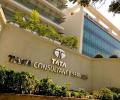
Tata Consultancy Services (TCS) - the largest information technology (IT) services provider in India and the second-largest globally - recently set an ambitious goal of $50 billion in revenue by 2030. The growth required to reach this goal, however, is lower than the company's own standards. In the past decade, TCS revenues, or net sales in US dollar terms, have grown at a compound annual growth rate (CAGR) of 9.5 per cent, from $10.2 in 2011-12, to an expected $25.3 billion during 2021-22 (FY22), based on its revenue trend in the first nine months of FY22.

A sharp sell-off in the Indian equities markets after a spike in crude oil prices should not be surprising. Historically there is a negative correlation between stock valuations in India and the price of Brent crude oil, which is the benchmark for the Indian crude oil basket. Between 2011 and 2014, crude oil traded above $100 a barrel for an extended period, the Sensex-trailing price/earnings (P/E) was 18X, on average, during the period, nearly 22 per cent lower than the current index P/E of 23X.

With the international markets facing uncertainty after Russia invaded Ukraine and Western nations retaliated with sanctions, Indian companies are putting their international fundraising plans on hold as they wait for the markets to recover. Bankers said apart from the geopolitical crisis, international rates are hardening in anticipation of interest rate hikes by the US Federal Reserve to control rising prices in the US. The Ukraine situation has implications for the market. In such a situation, international investors try to shift to safe haven assets by exiting from emerging markets.
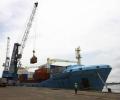
The auditor of ABG Shipyard, which is being probed by the Central Bureau of Investigation (CBI) for the Rs 23,000-crore default to banks, had settled an investigation by the Securities and Exchange Board of India (Sebi) by paying a small settlement fee in 2019. The regulator had initiated an investigation into the fund diversion from ABG Shipyard and had asked the auditor to explain why it failed to detect fund diversion in time. In his settlement application, auditor MN Ahmed, partner of Nisar & Kumar, a chartered accountant firm, said he ceased to be an Indian citizen and has retired from the profession.

The biggest jump in earnings and decline in P/E multiples has occurred with top companies in metals and mining, corporate banking, and the oil and gas sectors.
 © 2025 Rediff.com - Investor Information - Advertise with us - Disclaimer - Privacy Policy - Sitemap - Feedback - About us - Terms of use - Grievances